AirComplianceEngineering
  • Home
  • About Us
  • Services
    • FTIR Support
    • Indoor Air / Mold
  • Request Consultation
  • News/Articles
  • Resources

news & articles

View my profile on LinkedIn

NC Triad Air Quality Improves Dramatically

4/25/2017

0 Comments


Original article by Richard M. Barron from the Winston-Salem Journal:
http://bit.ly/2oiiYa5

GREENSBORO — These days, you can breathe easier in the Triad.

Air quality is improving partly because, like the rest of the nation, strict emission standards have put the squeeze on the worst pollutants, according to the American Lung Association’s annual State of the Air report.

Duke Energy was once a major air polluter. In the Triad, the company has installed expensive scrubbers at its Belews Creek Steam Station to remove dust particles from its smokestacks or converted other plants to natural gas.

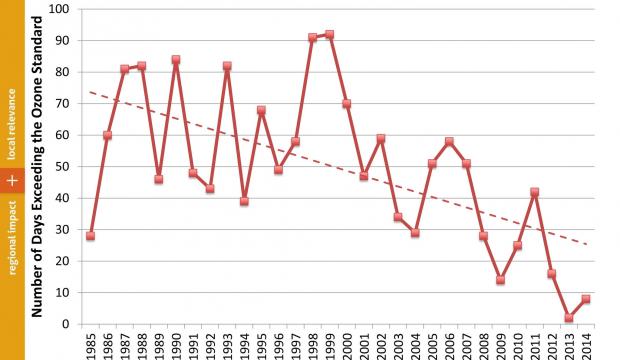
The Greensboro-Winston-Salem-High Point area had the fewest days of high-level ozone pollution since the group started producing reports 18 years ago, the Lung Association said.

The Triad was also one of the cleanest cities for short-term particle days — spikes in pollution that can last for hours to several days and can increase the risk of heart attacks and strokes.

​In North Carolina, the cleanest cities for ozone air pollution were Greenville-Washington, Hickory-Lenoir, New Bern-Morehead City and Wilmington.

Forsyth, Guilford and Rockingham counties were among the state’s cleanest for short-term particle pollution.

0 Comments

Air quality in Georgia improving

4/3/2017

3 Comments

 
Original Article by LeeShearer of OnlineAthens

Air quality in Georgia has improved markedly over the past decade, and that improvement is likely to continue in the foreseeable future, according to the Georgia Environmental Protection Division’s top air quality administrator.
Picture

Emissions of fine-particle pollution and ozone-forming chemicals have declined dramatically, said EPD Air Protection Branch Chief Karen Hays.


Emissions of ozone-forming sulfur dioxide (SO2) declined from more than 700,000 tons a year in 2005 to less than 100,000 tons in 2015, according to EPD records.
​

In the same 10 years, emissions of nitrous oxide and nitrous dioxide (NOX) have also come down sharply, though not as steeply as SO2.

NOX emissions rose to around 650,000 tons per year in 2007, but by 2014 and 2015 had dipped below 400,000, according to EPD’s monitoring data.

Because of the improvements, EPD has asked federal officials to drop seven metro Atlanta counties from the Atlanta “nonattainment” zone, where ozone levels all too frequently exceeded a federal standard meant to protect human health.

Under the EPD’s October 2016 recommendation, Paulding, Douglas, Coweta, Fayette, Cherokee, Forsyth and Newton counties would be dropped from the Atlanta nonattainment zone.
3 Comments
    • EPA News
    • EPA Air News
    • A&WMA Newswire
    • Source Evaluation Society News

    Archives

    November 2017
    October 2017
    April 2017
    March 2017
    February 2017
    January 2017

    Categories

    All
    Air Emissions
    Air Permit
    Air Quality
    Air Toxics
    CHP
    Coal
    Combined Heating And Power
    Combustion Turbine
    Dominion Power
    Duke Energy
    Electric Power
    Emissions
    Energy Efficiency
    Environmental Compliance
    Environmental Protection
    Formaldehyde
    Greenhouse Gas
    Landfill Gas
    Methane
    Nitric Oxide
    Nitrogen Dioxide
    NOx
    Oxides Of Nitrogen
    Ozone
    Ozone Attainment
    Ozone Nonattainment
    Particulate
    Reciprocating Engine
    Renewable
    SO2
    Sulfur Dioxide
    Utilities
    Wood Products

    RSS Feed

Proudly powered by Weebly
  • Home
  • About Us
  • Services
    • FTIR Support
    • Indoor Air / Mold
  • Request Consultation
  • News/Articles
  • Resources